
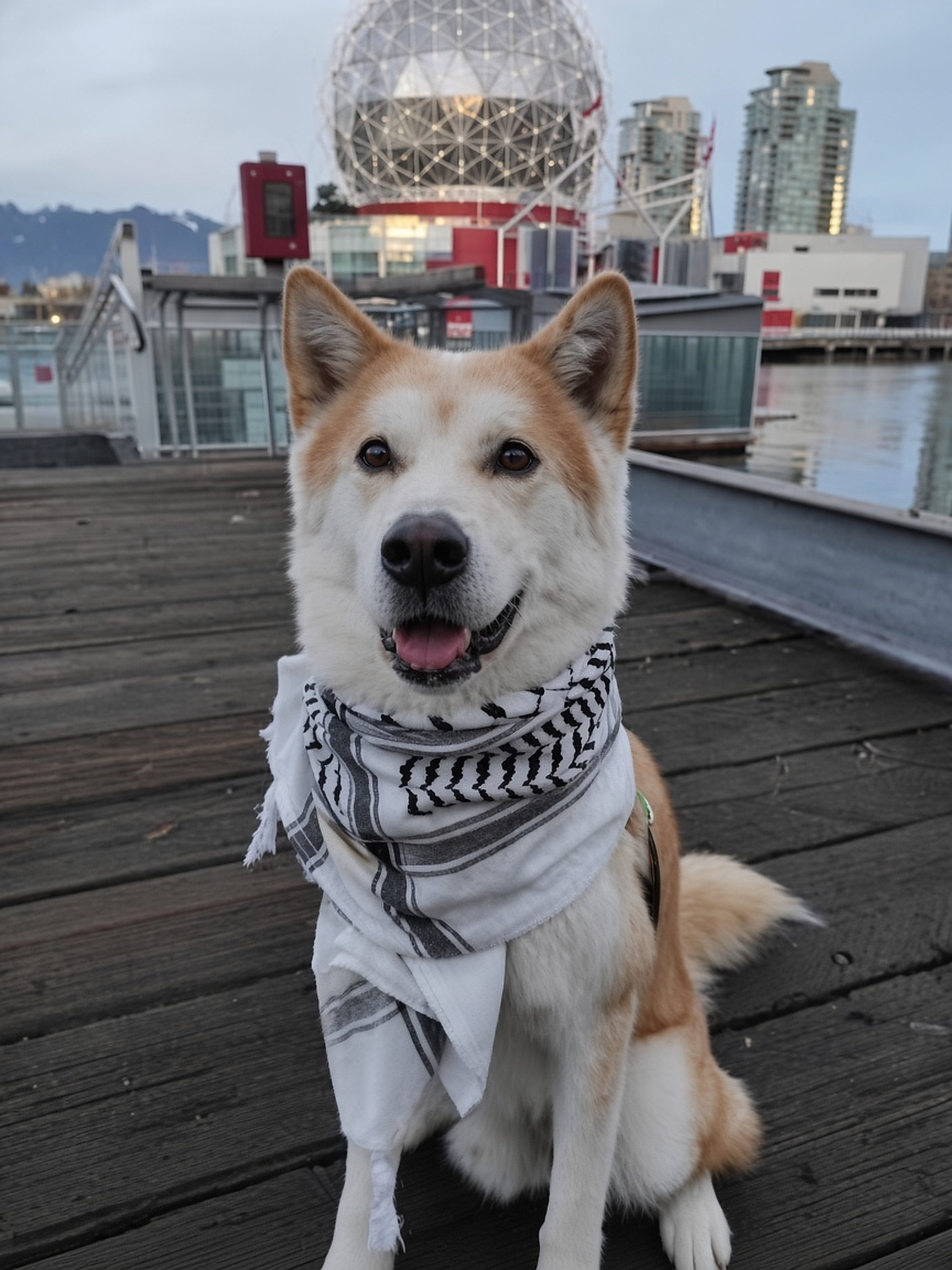
This week, we’ve shared with you an absolutely heartbreaking story about the street dogs of Palestine — and about one of them, a cream-coated survivor named Light, who is now going viral. People have started calling him The Final Inu.
Dogs in Palestine have been systematically killed. Shot. Poisoned. Hung. Run over for sport. Paid for by the head. Bombed as “shapes” in a street that used to be a neighborhood. Light is what is left when that machine has passed through: one dog who made it out, and a following that grew around him because the rest of the pack did not.
It is CRITICAL that his name is not lost, and that the killing of the dogs around him is not filed under nothing. Please, read this. Then donate if you can.
Here’s what happened…
The dog who lived
Look at the photograph. A cream dog sits as if the ground under him is still allowed to be a street. Upright ears. A mouth that has not yet learned to stop hoping. Someone has tied a keffiyeh at his throat — not a costume, not a joke. In this war a cloth like that is a country you can still put on a living body. Behind him, a city that is not rubble. That is part of why the picture travelled. It is a picture of a Palestinian street dog who is still here to be looked at.
They call him Light. In a place where the nights have been the color of artillery, that is not a soft name. It is an argument. You do not name a creature Light unless you intend, against every available fact, to keep him in the world.
The internet did the rest. Clips of him eating. Clips of him walking. Clips of a hand on his neck that is not a stick. The following arrived the way followings arrive now: first the neighbors, then the diaspora, then strangers who had never stood in that dust and still could not scroll past a dog who had. They started calling him The Final Inu — the last one, the one the feed would not let die quietly.
How you kill dogs on purpose
To understand why one surviving dog can build a following, you have to understand how cheap a street dog’s life has been made in Palestine. This is not a few cruel men. It is a system.
In November 2022, the mayor of Hebron, in the occupied West Bank, announced a cash bounty: the equivalent of about $5.50 for every stray dog caught and killed. The municipality called it a solution to overpopulation. What followed was not policy. It was a hunt. Dogs were shot in the street. They were hung. They were run over for sport. Killers filmed the work and posted the films, the way people post anything they are proud of and do not expect to be ashamed of later.
The bounty was a number so small it was almost an insult to arithmetic. Five dollars and fifty cents is less than a meal in many of the cities that later shared the videos in horror. It is enough, in a place where cash is scarce and cruelty is already in the water, to turn a living animal into a day’s wage. Our partner on the ground, the Animal and Environment Association (AEA), is the only registered shelter in Bethlehem and the West Bank. After the outcry, the mayor said he would submit a statement “suspending” the bounty. People kept killing dogs anyway. We were told that the killers consider it fun.
Then the war made the old hunt look like a rehearsal. Dogs have been shot for being shapes. Dogs have been left in streets that no longer have bakeries. Dogs have been used as weapons, sent into houses with cameras on their backs, trained to bite. The same species sits in Light’s skin and in an army harness. The difference is not moral philosophy. The difference is who is holding the leash, and whether there is a leash at all.
Street dogs in Palestine have always lived in a country inside the country. They are not pets in the Western sense and they are not wildlife. They are the unofficial census of hunger. When a city is poor, the dogs get thinner first. When a city is under blockade, the dogs drink from puddles that used to be water trucks. When a city is being bombed, the dogs do what every living thing does: they run until there is nowhere left to run, and then they lie down and wait to see if the waiting is a kind of death or a kind of mercy.
This is The Final Inu — one dog the system did not finish.
The following
Light was a neighborhood problem before he was a timeline. He belonged to no house and to every house. He learned the hours when the baker swept flour into the alley. He learned which children threw stones and which children saved the soft middle of the bread. He slept under a rusted water tank in winter and in the thin shade of a broken awning in summer.
The people who fed him were not an organization. They were a map of ordinary stubbornness. A woman who sold thyme on the corner kept a tin of scraps under the stall. A boy on a bicycle learned his name before he learned the names of the ministers on television. They argued, the way neighbors argue, about whether it was foolish to waste food on an animal while children were hungry. Then they kept wasting it. That is how a street dog becomes a public trust. Nobody owns him. Everybody is implicated.
“We called him Light because he came back. Even when the street went dark. Even when the other dogs stopped coming back.” — a neighbor who asked not to be identified
Then the videos started. Not a campaign. A phone, a dog, a keffiyeh, a mouth still willing to pant. The following grew because the comments were already a graveyard. People wrote the names of dogs that did not get a clip. People wrote: this one lived. People wrote: do not let them take him too. That is how The Final Inu stopped being a nickname and became a kind of census. One. Countable. Still breathing.
A following cannot feed a dog forever. It can keep a name from being erased. It can put money in the hands of the people who still bend down in a street that has been taught to step over lives. It can make it slightly more expensive, politically, to kill the animal everyone is watching.
We MUST get Light — and dogs like him — off the killing grounds before the following is all that is left of them.
Help us to take action by donating today!
The ones who stay with animals
Light is one dog. Around him is a profession of people who have been doing this work long enough to know how it ends. In 2006, Saeed Al-Err registered Sulala Animal Rescue in Gaza City — the first and, for a long time, the only licensed shelter of its kind in the Strip. He had started by feeding strays and by arguing with a municipal office that wanted them killed. He sold a car. He borrowed money for land. He built a place where a dog could be more than a vector for disease in a government memo.
When this war began, Sulala was told, like everyone else, to go south. They moved what they could: cats, disabled dogs, the animals who could not run. Some of the dogs walked kilometers back to the old shelter because that was the only map in their heads. A nineteen-year-old employee, Loay Rami Al-Wadi, was killed in the first days. The founder kept working. The animals ate rice and pasta and canned tuna that people also needed. “You cannot look at a creature that trusts you and eat in front of it without sharing,” Al-Err has said.
In October 2025, after a ceasefire was announced, a veterinarian named Dr. Mu’ath Abu Rukbeh tried to go home. He was thirty. He had a wife and two small sons. He had spent the war being the person you call in the middle of the night if a donkey is bleeding or a dog has a piece of metal in its leg. Sulala said he studied the map, tried to be careful, and crossed a “yellow line” that Israeli forces had drawn across other people’s lives. He went missing for nine days. His brother searched among bodies. On 19 October they found him. The Independent reported the killing.
“He was in a constant state of preparedness to come help any animal. We are very sorry to lose him.” — Sulala Animal Rescue, on Dr. Mu’ath Abu Rukbeh
These names are in the record because organizations exist to keep records. The dogs who were paid for by the head, and the dogs who were shot as shapes, are in a different kind of record: the oral one, the family one, the comment section under Light’s videos. Put them in the same paragraph anyway. The work is the same work. A person sees a creature that cannot negotiate and decides the creature will not be left to a bounty, or an army, or a timeline that scrolls past.
We MUST provide a bigger safe space where these dogs can be cared for and treated — they deserve it, especially after all their trauma.
Help us to take action by donating today!
What the photograph knows
Look at the picture again. The keffiyeh is the color of a street that still has a pattern. It has been tied the way you tie a scarf on a child who is going out into weather you cannot control. Light’s face has the particular expression street dogs invent, which is not quite trust and not quite accusation. It is the look of a creature who has been taught, incorrectly, that human beings are a system that can be appealed to.
If you came here from the old appeal about a bounty on street dogs’ heads, you are in the same country of concern. The bounty was a city hall trying to erase animals with cash. The war is a state trying to erase a people with munitions. Light is what is left when both machines have passed: a life that was never the intended target and was never, for a second, safe — and is now, almost accidentally, famous.
The math of one dog
There will be readers who are angry that this article exists. They will say: people are dying, and you are writing about a dog. They are not wrong about the dying. They are wrong about the “and.” The people who kept Light alive did not do so because they thought a dog was more important than a child. They did it because they were standing in a minute when the dog was the life in front of them, and they had not yet agreed to become the kind of people who step over a life.
War tries to teach a hierarchy of grief. It fails on the stubborn. A man who has watched his street come apart may still be unable to watch a dog shake. That inability is not sentimentality. It is the last un-colonized part of a nervous system. If you can still be reached by a pair of eyes and a keffiyeh, you are not yet entirely a function of the army’s categories.
Light does not know he is a symbol. He does not know he is The Final Inu. He knows the cloth at his throat. He knows certain voices and the smell of certain hands. He knows that people keep arriving now — not only with bread, but with phones. A following is not food. It is a kind of witness. The decent thing, which is also the insufficient thing, is to turn the witness into a shelter, a vet, a bowl that does not depend on a viral week.
Please, help us raise as much as possible to get Light and dogs like him off the street, treat the injured, and keep the names of the dead beside his.
Help us to take action by donating today!
How a light stays lit
The work that remains is unromantic. Dogs need food that is actually food. They need a person who will sit through the night when the infection starts. They need a law that does not pay $5.50 for a corpse. They need a war to end, which is a sentence that feels almost rude in its obviousness and is still the only sentence that would make the rest of this article unnecessary.
Until that happens, Light is alive in the way a ceasefire is alive: day by day, contingent, surrounded by people who are themselves trying not to be killed. The following will thin if we let it. The killing will not thin on its own. The names of the dogs who did not get a camera will be said in kitchens and, when the families allow it, in public.
The time for serious action is NOW. We urgently need your help. Please donate what you can today. Whatever you send enables us to help save the dogs of Palestine — and to keep the one dog the internet refused to let die quietly from becoming a eulogy with a comment count.
There was a slaughter. It was systematic. Then there was a dog named Light, and a cloth at his throat, and a following that would not look away. If you need that to be a metaphor for Palestine, it will bear the metaphor. If you need it to be only a dog story, it will bear that too. The photograph does not require your interpretation. It requires that you not scroll past as if scrolling past were a kind of innocence.
Light is still here. Say his name the way the street said it when the other dogs stopped coming back. The Final Inu. A cream dog in a keffiyeh, looking at you with the last unarmed thing in the frame.
 Afrikaans
 Albanian
 Amharic
 Arabic
 Armenian
 Azerbaijani
 Basque
 Belarusian
 Bengali
 Bosnian
 Bulgarian
 Catalan
 Cebuano
 Chichewa
 Chinese (Simplified)
 Chinese (Traditional)
 Corsican
 Croatian
 Czech
Czech Danish
 Dutch
Dutch English
 Esperanto
 Estonian
 Filipino
 Finnish
 French
 Frisian
 Galician
 Georgian
 German
 Greek
Greek Gujarati
 Haitian Creole
 Hausa
Hausa Hawaiian
 Hebrew
 Hindi
Hindi Hmong
Hmong Hungarian
 Icelandic
 Igbo
Igbo Indonesian
 Irish
Irish Italian
 Japanese
 Javanese
 Kannada
 Kazakh
 Khmer
Khmer Korean
 Kurdish (Kurmanji)
 Kyrgyz
 Lao
Lao Latin
Latin Latvian
 Lithuanian
 Luxembourgish
 Macedonian
 Malagasy
 Malay
Malay Malayalam
 Maltese
 Maori
Maori Marathi
 Mongolian
 Myanmar (Burmese)
 Nepali
 Norwegian
 Pashto
 Persian
 Polish
 Portuguese
 Punjabi
 Romanian
 Russian
 Samoan
 Scottish Gaelic
 Serbian
 Sesotho
 Shona
Shona Sindhi
 Sinhala
 Slovak
 Slovenian
 Somali
 Spanish
 Sundanese
 Swahili
 Swedish
 Tajik
Tajik Tamil
Tamil Telugu
 Thai
Thai Turkish
 Ukrainian
 Urdu
Urdu Uzbek
Uzbek Vietnamese
 Welsh
Welsh Xhosa
Xhosa Yiddish
 Yoruba
 Zulu
Zulu English
